Rheumatology
Mechanical vs Inflammatory Joint Pain: How to Tell the Difference
Short on time?
We can email you a concise summary of this article to read later.

Two knees, two different problems
Two people both say, "my knee hurts." The first feels fairly comfortable on waking but is sore after a long day on their feet or a flight of stairs, and rest helps. The second wakes up stiff and swollen, takes the better part of an hour to loosen up, and feels better once moving. Both have knee pain. The cause, and the right kind of care, may be quite different.
Doctors often sort joint pain into two broad patterns. Mechanical pain is linked to loading, wear or injury of the joint and the tissues around it. Inflammatory pain happens when the joint lining itself is inflamed, which can occur in autoimmune conditions such as rheumatoid arthritis, in crystal arthritis such as gout, or in infection.
Neither pattern can be diagnosed from symptoms alone. But noticing which one sounds more like you gives your doctor a useful head start.
Mechanical vs inflammatory joint pain at a glance
| Feature | Mechanical pattern | Inflammatory pattern |
|---|---|---|
| Onset | May follow an injury or repeated loading, or build up slowly | Often gradual, sometimes sudden |
| Rest and activity | Often worse with use and better with rest | Often worse after rest or inactivity; gentle movement may ease it |
| Morning stiffness | Usually absent or brief, often 30 minutes or less1 | Often longer, around 30 to 60 minutes or more |
| Night pain | Can occur, especially after a busy day or in advanced joint wear | May wake you in the second half of the night |
| Swelling | May be absent, or mild. | Persistent swelling, warmth or tenderness of the joint lining may occur |
| Fatigue and other symptoms | Usually absent unless another condition is present | Tiredness, low-grade fever, or skin, eye or bowel symptoms may occur |
| Typical conditions | Osteoarthritis, tendon problems, cartilage or meniscus injury | Rheumatoid arthritis, psoriatic arthritis, axial spondyloarthritis, gout |
These are tendencies, not rules. Osteoarthritis can cause swelling, stiffness and night pain. Inflammatory conditions can also hurt after activity. Gout and joint infection can start suddenly. The 30 and 60 minute figures are rough guides used in clinical guidance, not exact dividing lines, and no single feature reliably separates every mechanical problem from every inflammatory one.
Three everyday examples
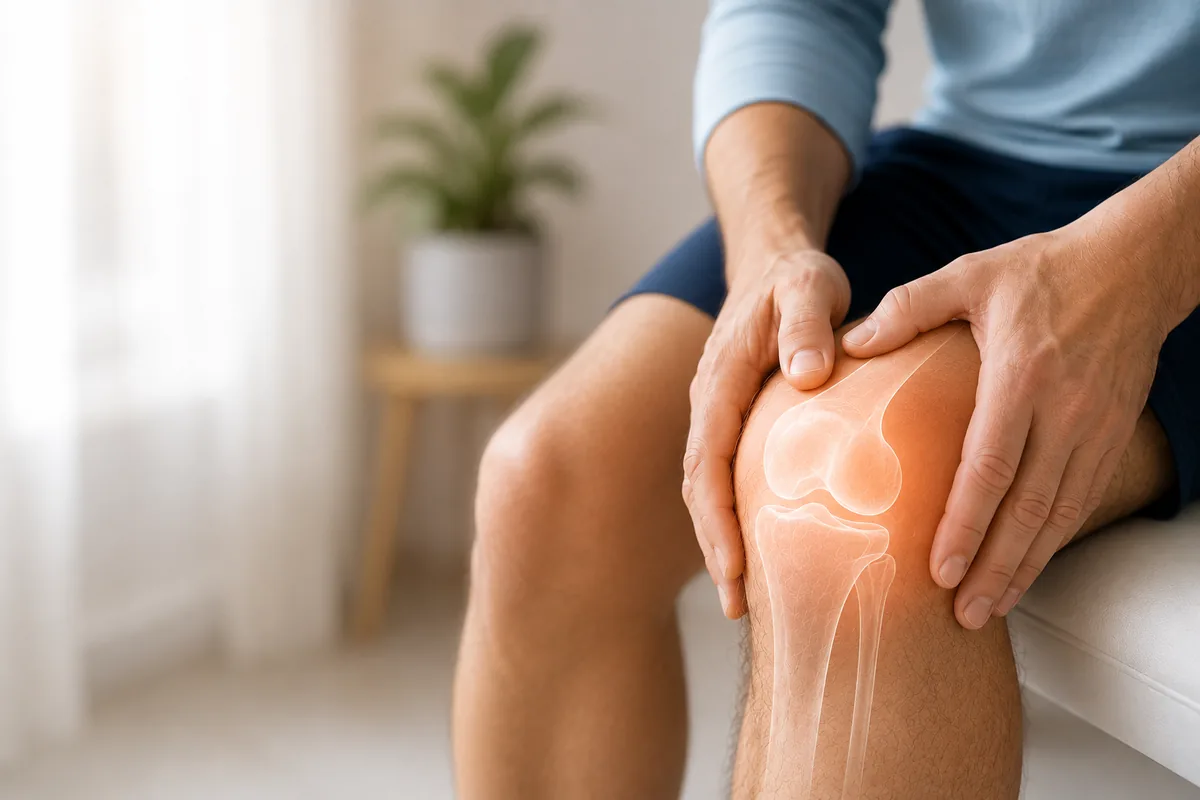
The knee. Pain that builds after stairs, long walks or standing, and settles with rest, with only a few minutes of stiffness on waking, fits a mechanical pattern. The knee may also feel stiff after sitting, but it loosens within minutes. Pain with a persistently swollen, warm knee and stiffness that takes much longer to ease raises the question of inflammation.1
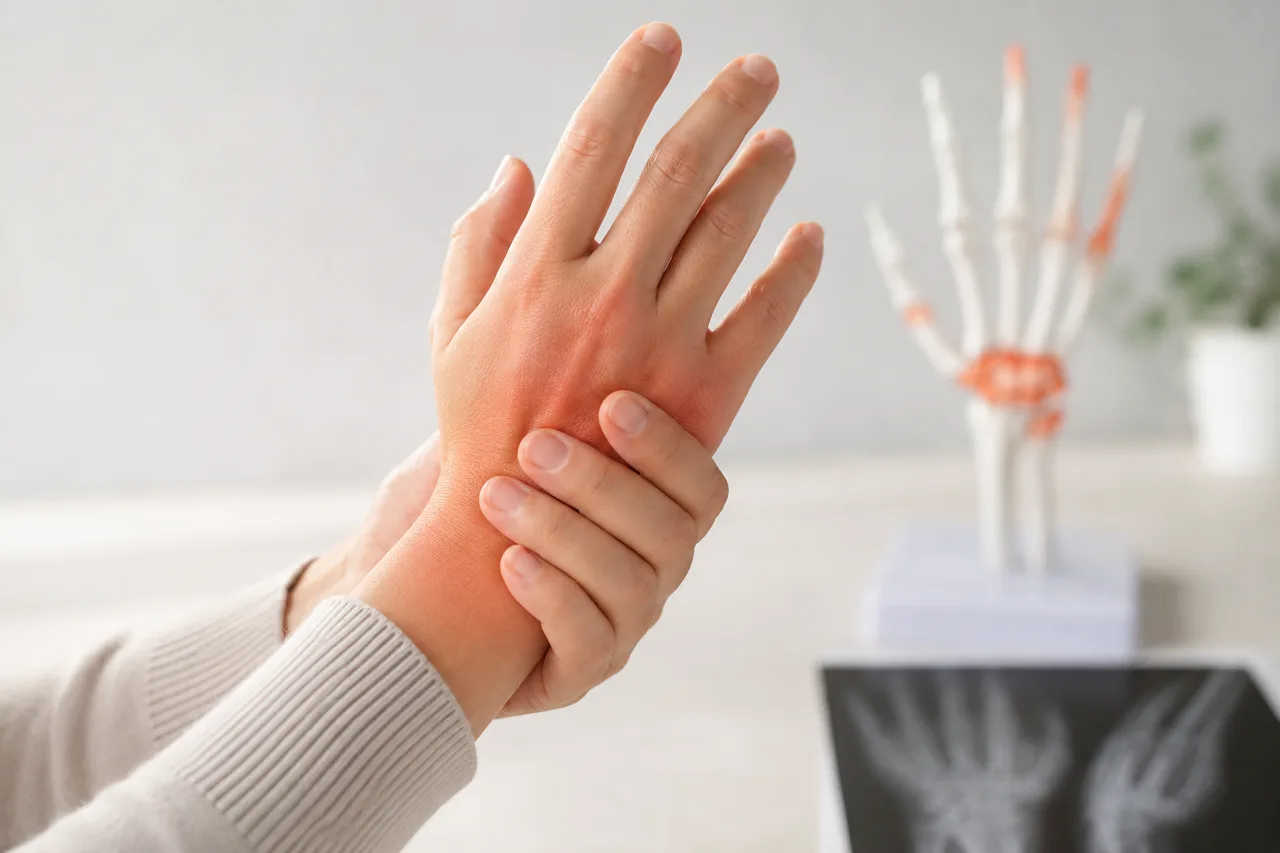
The hands. Soreness at the base of the thumb or the end joints of the fingers when gripping, opening jars or typing, easing with rest, is typical of a mechanical problem. Swelling and stiffness in several small joints of both hands, such as the knuckles and middle finger joints, lasting well beyond the first half hour of the day, points to an inflammatory pattern.2
The lower back. Back pain after lifting or bending, that varies with position and eases when you lie down, is usually mechanical. Back pain that began gradually before the age of 40, has lasted more than three months, is worse after rest and in the second half of the night, and improves with exercise, fits the inflammatory back pain pattern described by expert criteria. It is a reason for assessment, not a diagnosis.34
When joint pain needs urgent care
Most joint pain can be assessed at a routine appointment. Some patterns should not wait.
- Same-day emergency care: a joint that suddenly becomes hot, red, swollen and very painful, especially with fever, feeling unwell or being unable to put weight on it. A joint infection must be considered and can damage a joint quickly, even when there is no fever.5
- Emergency care: a significant injury with deformity or inability to bear weight, or back pain with new bladder or bowel problems, numbness around the groin or inner thighs, or growing leg weakness.
- Prompt medical review: persistent pain at night that you cannot explain, particularly with fever or unexplained weight loss.
- Same-day eye assessment: a painful red eye with sensitivity to light or blurred vision, particularly if you have back pain or a known spondyloarthritis.3
In an emergency, please call 998 for an ambulance or go to the nearest emergency department.
Who should you see?
| Situation | Who to see |
|---|---|
| Hot, swollen joint with fever; major injury; back pain with bladder, bowel or nerve symptoms | Emergency department |
| Uncomplicated pain linked to activity, strain or deconditioning | Your primary care doctor, a physiotherapist or the consultant rheumatologist |
| Suspected structural problem such as a torn ligament or meniscus, or a joint that locks or gives way | Orthopedic surgeon |
| Persistent swelling, long morning stiffness, several joints affected, back pain with inflammatory features, or symptoms that do not fit one pattern | Consultant Rheumatologist |
Persistent swelling of a joint, especially in several joints or in the small joints of the hands and feet, deserves prompt rheumatology assessment even when blood tests are normal. Normal blood tests do not rule out inflammatory arthritis.2
How a Consultant Rheumatologist works out the pattern
The assessment starts with your story and an examination. The key question is whether there is true inflammation of the joint, such as swelling and warmth, or pain without it. The doctor also looks at which joints are involved, how symptoms behave over a day, and whether other parts of the body are affected, such as the skin, eyes, gut or energy levels.
Tests are chosen according to what is found. Blood tests can support the assessment but cannot make it alone, and normal inflammatory markers do not exclude inflammatory arthritis.2 Imaging is selected to answer a specific question, not ordered for everyone.1
How to prepare for your appointment
It helps to note, if you can:
- when the pain started, and whether it came on suddenly or slowly
- whether movement makes it better or worse, and whether rest does
- how long the morning stiffness lasts
- whether you have seen any swelling or redness
- any rash, eye symptoms, bowel symptoms, fever or unexplained tiredness
- earlier treatments and test results, including X-rays and blood tests
Frequently Asked Questions
Can joint pain be both mechanical and inflammatory?
Yes. Osteoarthritis is a mechanical problem that can also cause inflammation, and a person with inflammatory arthritis can have mechanical problems too. Mixed features are common, which is why an assessment helps.
How long should morning stiffness last?
Stiffness of up to about 30 minutes is typical of mechanical problems such as osteoarthritis. Stiffness that lasts longer, especially an hour or more, is more typical of inflammatory arthritis. These are guides, not exact rules.1
Does a normal blood test mean it is not inflammatory arthritis?
No. Blood tests support the assessment but do not decide it alone, and persistent joint swelling still deserves assessment even when they are normal.2
Is pain at night a sign of inflammatory arthritis?
Not by itself, because mechanical problems can also cause night pain. Pain in the second half of the night that eases when you get up and move is more typical of inflammatory back pain.34
Do I need an X-ray or MRI?
Not always. Imaging is chosen according to your history and examination, to answer a specific question.1
When should I see a Consultant Rheumatologist?
Consider an assessment if you have persistent joint swelling, morning stiffness that lasts longer than half an hour, several joints affected, back pain with inflammatory features, or symptoms that do not fit a single pattern.
If your joint pain is still unexplained
If your pain has no clear cause, or your symptoms suggest inflammatory arthritis, an in-person assessment with Dr Bassel Darwish, Consultant Rheumatologist at Health Call Clinic in Dubai Healthcare City, can help decide which investigations and next steps are appropriate. Learn about our rheumatology service.
This article is for general information and does not replace a medical assessment.
Clinical references
Sources consulted while preparing this article. Links open the original guideline or publication.
- 1.Osteoarthritis in over 16s: diagnosis and management (NG226)National Institute for Health and Care Excellence · 2022↑ back to text
- 2.Rheumatoid arthritis in adults: diagnosis and management (NG100)National Institute for Health and Care Excellence (updated 2020) · 2018↑ back to text
- 3.Spondyloarthritis in over 16s: diagnosis and management (NG65)National Institute for Health and Care Excellence · 2017↑ back to text
- 4.New criteria for inflammatory back pain in patients with chronic back pain: a real patient exercise by experts from the Assessment of SpondyloArthritis international Society (ASAS)Sieper J, van der Heijde D, Landewe R, et al. Ann Rheum Dis. 2009;68(6):784-788 · 2009↑ back to text
- 5.Guideline for management of septic arthritis in native joints (SANJO)Ravn C, Neyt J, Benito N, et al. J Bone Jt Infect. · 2023↑ back to text
Find our health articles useful? Add Health Call Clinic as a Preferred Source on Google.
Have a question about this topic?
Our clinicians are happy to answer general educational questions related to this article.
We can't provide a diagnosis, recommend treatment, or comment on an individual medical case without a proper clinical assessment. If your question concerns your own symptoms, diagnosis, medications, test results, or treatment, please book an appointment so we can help you properly.
Please don't send medical records or sensitive personal health information through this educational Q&A.
Written by Dr Bassel Darwish
Consultant Rheumatologist
Credentials & training

ABIM Board Certified — Internal Medicine · Rheumatology

Fellow, American College of Rheumatology (FACR)

Rheumatology Fellowship, 1997–1999 — University of Wisconsin School of Medicine and Public Health
Talk to an expert at Health Call Clinic
In-clinic rheumatology, psychiatry and counseling, plus DHA-approved online psychiatry consultations at Dubai Healthcare City.