Rheumatology
Which Specialist Do You Need? A Rheumatologist or an Orthopedic Surgeon?

One of the most common questions patients ask
"I have pain in my knee. So… should I see a rheumatologist or an orthopedic surgeon?"
It depends on why the joint hurts. Both specialties care for joints, muscles, bones and connective tissues, and the boundary between them is not a simple medical-versus-surgical divide.
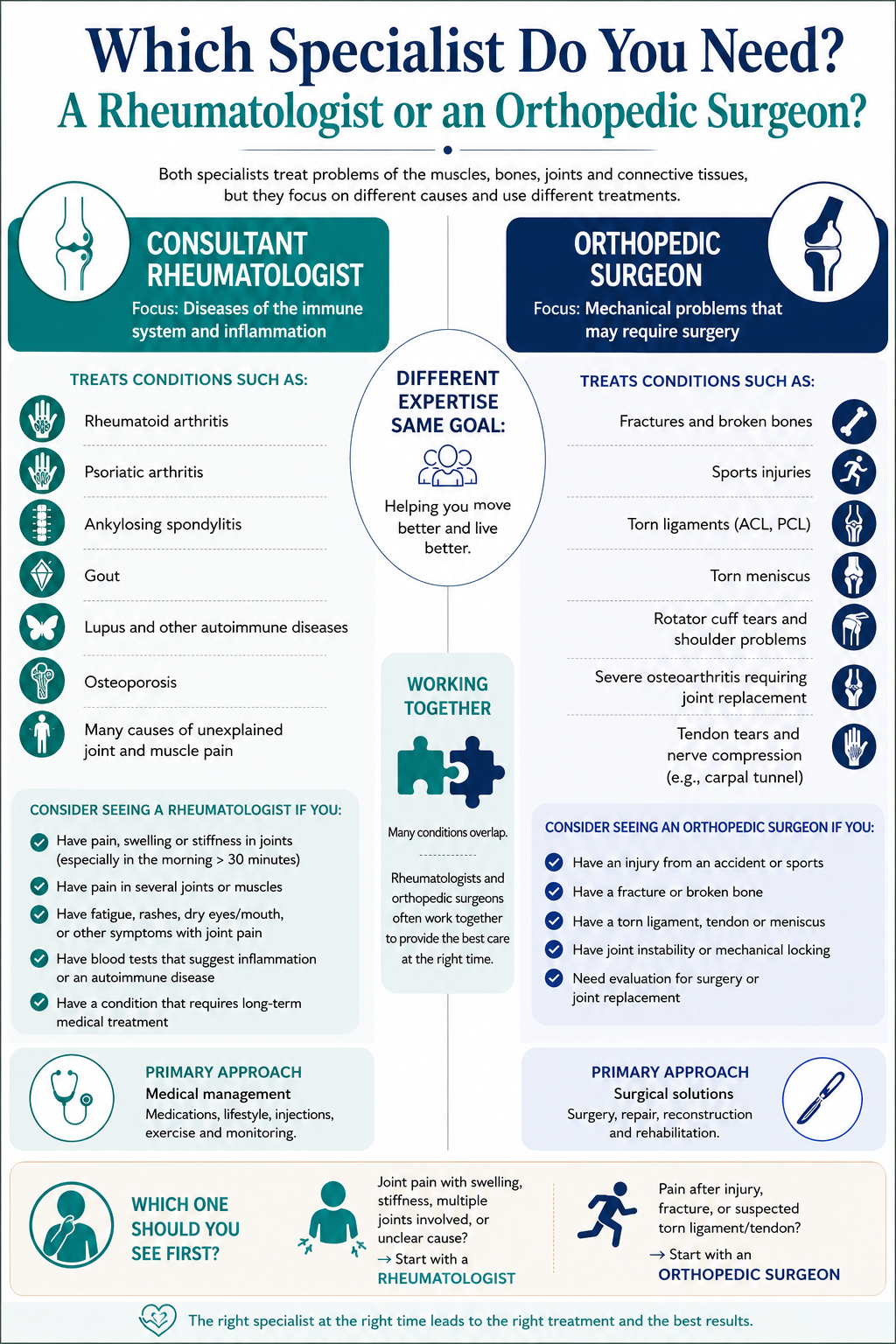
Rheumatologists are physicians who assess and manage inflammatory, autoimmune, metabolic and many non-surgical musculoskeletal conditions. Orthopedic surgeons specialize in musculoskeletal injuries, structural disorders and operative care, while also offering non-operative management in appropriate cases.
The infographic below summarises the general emphasis of each specialty.
What rheumatologists commonly assess
- Rheumatoid arthritis, psoriatic arthritis and axial spondyloarthritis
- Gout and other crystal arthritis
- Lupus, vasculitis and other autoimmune diseases
- Osteoporosis and metabolic bone disease
- Many non-surgical and unexplained causes of joint and muscle pain
Rheumatology assessment is often helpful when there is persistent joint swelling of unclear cause. Adults with suspected persistent synovitis of undetermined cause should be referred for specialist assessment, and referral should not be delayed by normal inflammatory markers or negative rheumatoid factor or anti-CCP results.1
Inflammatory spinal symptoms — for example back pain that began before the age of 45 with an insidious onset and prolonged morning stiffness — and associated features such as psoriasis, uveitis or inflammatory bowel disease are reasons to consider assessment for spondyloarthritis. They raise the possibility of the diagnosis; they do not confirm it.2
What orthopedic surgeons commonly assess
- Fractures and acute bone injury
- Sports injuries
- Torn ligaments and meniscal injury
- Rotator cuff tears and other structural shoulder problems
- Osteoarthritis being considered for joint replacement
- Tendon tears and nerve compression such as carpal tunnel syndrome
Orthopedic teams also provide non-operative care — injections, bracing, activity modification and rehabilitation — so seeing a surgeon does not mean surgery is the expected outcome.
Osteoarthritis: usually managed without surgery first
Most osteoarthritis is initially managed non-surgically, with education, exercise, weight management where relevant, and pharmacological options. Referral for joint replacement is considered when symptoms substantially affect quality of life and non-surgical management has been ineffective or is unsuitable.3
Tests are chosen for the suspected condition
There is no single first or best test for joint pain. X-rays answer some questions and not others; ultrasound, MRI and blood tests each have a role depending on what is suspected. Imaging is not the property of one specialty — the choice follows the clinical question, and both rheumatologists and orthopedic surgeons request MRI when it is appropriate.
Overlap is normal, and care is often shared
Many presentations do not fit neatly into one specialty. Someone with long-standing inflammatory arthritis may need rheumatology care to control the disease and, at some point, an orthopedic opinion about a damaged joint. Someone referred to orthopedics for knee pain may turn out to have an inflammatory cause. Referral between the two is routine, and neither choice is a wasted step.
Which one should you see first?
There is no rule based only on how long pain has lasted, your age, whether one or several joints are involved, or whether symptoms followed an injury. In practice:
- Persistent joint swelling, inflammatory-pattern stiffness, or systemic features alongside joint pain often lead to rheumatology assessment.
- Injury with mechanical symptoms, instability or suspected structural damage often leads to orthopedic assessment.
Either specialist can redirect you if the initial impression changes.
Seek urgent care if
- You may have a fracture or dislocation
- A single joint becomes acutely hot, swollen and painful, especially with fever — a possible joint infection
- There is loss of circulation or sensation, or new weakness in a limb
A final thought
The useful question is not which specialty is better, but which is best placed to assess your presentation now — and to involve the other when that becomes helpful.
Dr. Bassel Darwish is a US board-certified Consultant Rheumatologist at Health Call Clinic, Dubai Healthcare City.
Clinical references
Sources consulted while preparing this article. Links open the original guideline or publication.
- 1.Rheumatoid arthritis in adults: managementNational Institute for Health and Care Excellence · 2018↑ back to text
- 2.Spondyloarthritis in over 16s: diagnosis and managementNational Institute for Health and Care Excellence · 2017↑ back to text
- 3.Osteoarthritis in over 16s: diagnosis and managementNational Institute for Health and Care Excellence · 2022↑ back to text
Find our health articles useful? Add Health Call Clinic as a Preferred Source on Google.
Have a question about this topic?
Our clinicians are happy to answer general educational questions related to this article.
We can't provide a diagnosis, recommend treatment, or comment on an individual medical case without a proper clinical assessment. If your question concerns your own symptoms, diagnosis, medications, test results, or treatment, please book an appointment so we can help you properly.
Please don't send medical records or sensitive personal health information through this educational Q&A.
Talk to an expert at Health Call Clinic
In-clinic rheumatology, psychiatry and counseling, plus DHA-approved online psychiatry consultations at Dubai Healthcare City.