Rheumatology
Gout in Filipinos: Why Is It Common and What Can You Do About It?
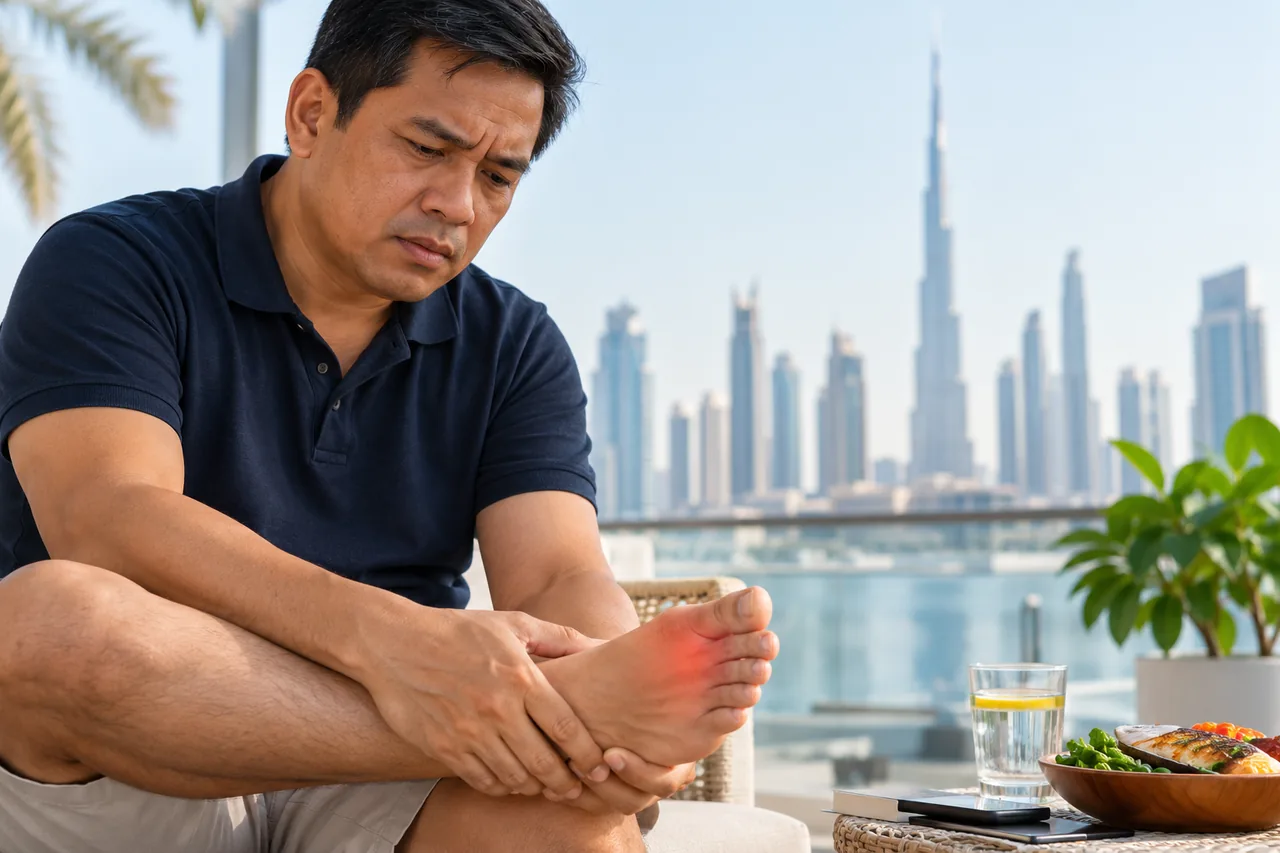
Gout is one of the most painful forms of inflammatory arthritis. For many Filipino families, it is also a familiar condition.
This is not simply a stereotype about diet. Research suggests that Filipino people may have a relatively high susceptibility to elevated uric acid and gout, with genetics, metabolic health, kidney function, medications, diet, and other factors all potentially contributing.
For Filipinos living in Dubai and elsewhere in the UAE, understanding this risk can be particularly useful — because gout is a treatable condition, and recurrent attacks should not simply be accepted as something you have to live with.
How common is high uric acid among Filipinos?
A Philippine population study of adults aged 20 years and older found hyperuricemia in 28.4% of the population. Among men, the prevalence was 31.7%, compared with 17.3% among women.1
Importantly, high uric acid is not the same thing as gout. Many people with hyperuricemia never develop gout. Gout occurs when monosodium urate crystals accumulate in and around joints and trigger inflammation.
Nevertheless, a population with relatively frequent hyperuricemia may also have more people at risk of developing gout.
Why might Filipinos be more susceptible to gout?
There is probably no single explanation.
Genetics may play a role
One area of research involves ABCG2, a transporter involved in removing urate from the body.
Studies of Filipino participants have found a relatively high frequency of the gout-associated ABCG2 rs2231142 variant. In one genetic study of Filipino participants, the gout-risk allele occurred at a frequency of approximately 46%, compared with about 12% in a Caucasian comparison sample.2
This does not mean that a Filipino person carrying the variant will develop gout. Gout is influenced by multiple genes together with environmental and health factors. But the findings provide a plausible biological explanation for some of the increased susceptibility observed in Filipino populations.
Metabolic health matters
Gout frequently occurs alongside conditions such as obesity, hypertension, diabetes, metabolic syndrome, and kidney disease.
These factors can influence how the body produces and eliminates uric acid. In Filipino patients, as in other populations, assessing gout therefore involves more than simply looking at what someone eats.
Diet can contribute — but gout is not simply a dietary disease
People with gout are often told to stop eating particular foods and assume that this will solve the problem.
Diet can certainly influence serum urate. Alcohol, sugar-sweetened beverages, and some purine-rich foods can contribute to gout risk or provoke attacks in susceptible individuals.3
But blaming gout entirely on food can be misleading.
Someone with a strong biological predisposition may continue to have high uric acid despite making substantial dietary changes. Conversely, many people eat purine-containing foods without ever developing gout.
For this reason, dietary improvement is useful but should not replace appropriate medical assessment when gout is recurrent.
Filipino food does not need to become a list of forbidden foods
A gout diagnosis should not mean abandoning Filipino cuisine.
Rather than creating an unrealistic list of foods that can never be eaten again, it is generally more useful to look at the overall pattern: portion size, alcohol, sugary drinks, weight when relevant, hydration, kidney function, medications, and how frequently particularly purine-rich foods are consumed.
Treatment should fit the person rather than turning every meal into a medical calculation.
Why do gout attacks keep coming back?
A gout attack may disappear completely after several days, but the underlying urate crystal deposits do not necessarily disappear with it.
This creates one of the common misunderstandings about gout: no pain does not necessarily mean no disease.
If serum urate remains sufficiently high, crystals can continue accumulating between attacks. Over time, some people develop increasingly frequent attacks, chronic arthritis, joint damage, or tophi — visible or palpable deposits of urate crystals.
When should uric-acid-lowering treatment be considered?
Not everyone with an isolated high uric acid result needs medication.
However, urate-lowering treatment is commonly considered in people with established gout who have features such as recurrent attacks, tophi, or gout-related joint damage.3
Current American College of Rheumatology guidance recommends a treat-to-target approach for patients receiving urate-lowering therapy, with treatment adjusted using serum urate measurements and a usual target below 6 mg/dL.3
Allopurinol is generally the preferred first-line urate-lowering medication, including for many patients with chronic kidney disease, although treatment must be individualized.3
Why can gout sometimes get worse after starting treatment?
This can be confusing.
When urate-lowering therapy begins and tissue urate levels start changing, gout attacks can temporarily become more likely. This does not necessarily mean the medication is making the disease worse.
For this reason, anti-inflammatory prophylaxis is often prescribed when urate-lowering treatment is started and continued for several months when appropriate.3
Stopping urate-lowering medication every time an attack occurs can interfere with successful long-term treatment.
When should you see a rheumatologist?
Consider medical assessment if you have:
- repeated attacks of sudden severe joint pain and swelling;
- attacks involving the big toe, ankle, knee, or other joints;
- persistently elevated uric acid together with symptoms suggestive of gout;
- lumps that may represent tophi;
- gout together with kidney disease or kidney stones;
- uncertainty about whether the problem really is gout; or
- continued attacks despite treatment.
Other conditions — including joint infection — can sometimes resemble gout, so a new severely painful swollen joint should not automatically be assumed to be gout.
Gout treatment in Dubai
Dubai has a large and diverse Filipino community, and gout is a condition encountered in rheumatology practice.
For Filipino patients with recurrent gout, the important question is usually not simply "What food should I stop eating?"
A better set of questions is: Is this definitely gout? Why is my uric acid elevated? Do I need long-term treatment? And if I do, has my serum urate actually reached the appropriate target?
Understanding those questions can turn gout from a cycle of repeated painful attacks into a condition that can often be controlled very effectively.
For more information about assessment and treatment, see our gout treatment in Dubai service page.
— Dr. Bassel Darwish, Consultant Rheumatologist, Health Call Clinic, Dubai Healthcare City
Clinical references
Sources consulted while preparing this article. Links open the original guideline or publication.
- 1.Serum Uric Acid and its Relationship with Demographic Characteristics among Filipino Adults 20 Years Old and Above: Results from the NNHeS 2003Philippine Journal of Internal Medicine · 2008 · doi:10.3860/pjim.v46i6.888↑ back to text
- 2.The prevalence of the gout-associated polymorphism rs2231142 G>T in ABCG2 in a pregnant female Filipino cohortClinical Rheumatology · 2020 · doi:10.1007/s10067-020-04994-9↑ back to text
- 3.2020 American College of Rheumatology Guideline for the Management of GoutArthritis Care & Research · 2020 · doi:10.1002/acr.24180↑ back to text
Find our health articles useful? Add Health Call Clinic as a Preferred Source on Google.
Have a question about this topic?
Our clinicians are happy to answer general educational questions related to this article.
We can't provide a diagnosis, recommend treatment, or comment on an individual medical case without a proper clinical assessment. If your question concerns your own symptoms, diagnosis, medications, test results, or treatment, please book an appointment so we can help you properly.
Please don't send medical records or sensitive personal health information through this educational Q&A.
Written by Dr Bassel Darwish
Consultant Rheumatologist
Credentials & training
ABIM Board Certified — Internal Medicine · Rheumatology

Fellow, American College of Rheumatology (FACR)

Rheumatology Fellowship, 1997–1999 — University of Wisconsin School of Medicine and Public Health
Talk to an expert at Health Call Clinic
In-clinic rheumatology, psychiatry and counseling, plus DHA-approved online psychiatry consultations at Dubai Healthcare City.