Rheumatology
Lupus in Arab and Middle Eastern Women: Symptoms, Risks and When to See a Rheumatologist

Lupus affects every background — but regional data matters
Systemic lupus erythematosus (SLE) affects people of every ethnic and geographic background, and being Arab or Middle Eastern does not cause lupus. At the same time, studies from the UAE and across the Arab world make it clear that lupus is an important health issue in our region, and they suggest that kidney involvement deserves particular attention when caring for Arab patients.12 This article explains what lupus is, what the regional evidence does — and does not — tell us, which symptoms women should recognize, and when to seek a lupus assessment and treatment in Dubai.
What is systemic lupus erythematosus (SLE)?
SLE is a chronic autoimmune disease in which the immune system mistakenly attacks the body's own tissues. It can involve the joints, skin, kidneys, blood cells, heart, lungs and nervous system, and its severity ranges from mild to life-threatening. Lupus most often begins in women of childbearing age, although men and children can be affected too. Because it can look like many other conditions, lupus is sometimes called "the great imitator" — which is one reason diagnosis can take time.3
Why discuss lupus in Arab and Middle Eastern women?
Two pieces of regional evidence are worth understanding carefully.
First, a study of the native Arab population of the UAE reported an age-standardized SLE prevalence of about 103 per 100,000 people in that specific population.1 This tells us lupus is a real and measurable health concern in the local population — but the figure describes that particular studied population and should not be applied to every Arab community or to the UAE's multinational population as a whole.
Second, a systematic review and meta-analysis pooled 22 observational studies covering 3,273 SLE patients across the Arab world. About 89% of those patients were women, and renal manifestations were reported in roughly half of the pooled patients.2 Two cautions matter here: the included studies were heterogeneous in design and quality, and "half of pooled patients showed renal manifestations" is very different from saying "half of Arab women develop nephritis." The sensible takeaway is not genetic determinism — it is that women in our region with possible lupus symptoms deserve timely assessment, and that kidney monitoring is a priority once lupus is diagnosed.
Symptoms women should recognize
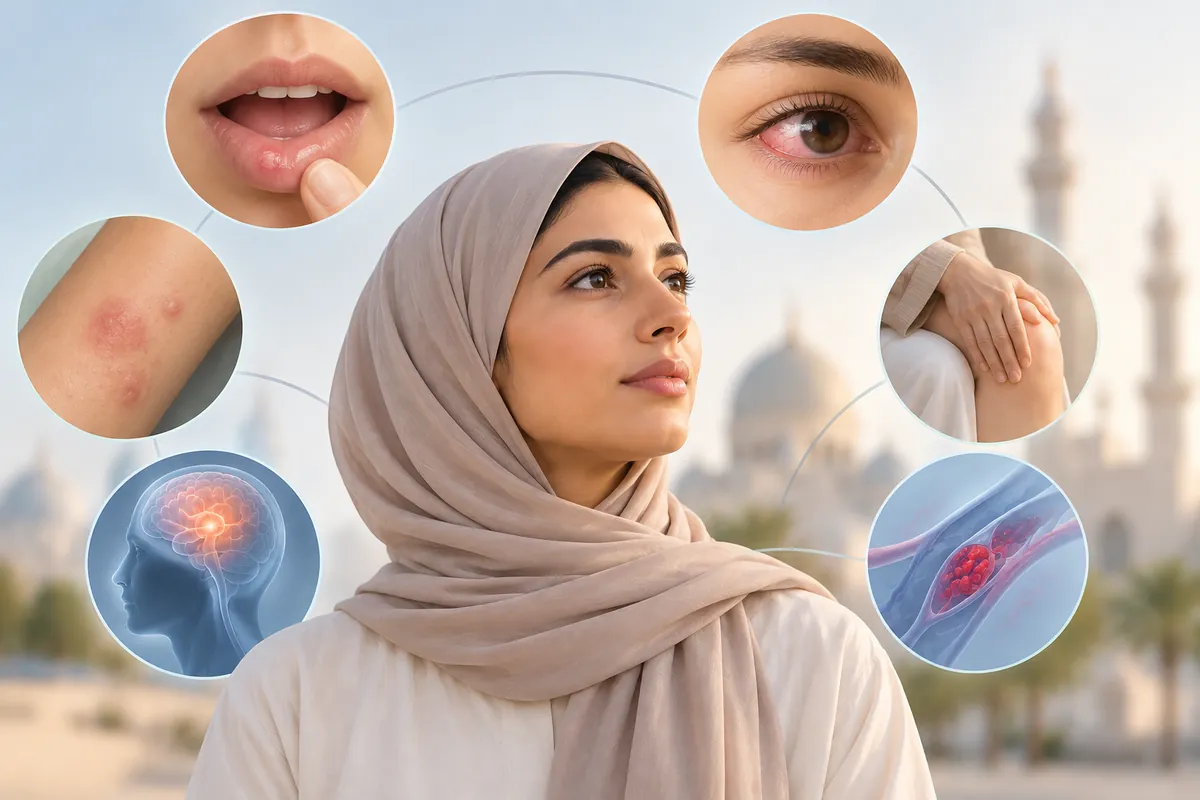
No single symptom proves lupus — each of the following has many possible causes, and it is the pattern over time that matters:
- Inflammatory joint pain and swelling, often in the hands, wrists or knees, sometimes with morning stiffness
- Persistent fatigue that is out of proportion to daily activity
- Photosensitive or malar ("butterfly") rash across the cheeks and nose, or other rashes that worsen with sun exposure
- Hair loss, often diffuse rather than in one patch
- Painless mouth or nose ulcers that recur
- Unexplained fevers
- Raynaud phenomenon — fingers turning white or blue in the cold
- Chest pain with deep breathing, swollen legs, or other signs that internal organs may be involved
Because these symptoms overlap with other conditions — including rheumatoid arthritis and fibromyalgia — our article on telling lupus, rheumatoid arthritis and fibromyalgia apart may also be helpful.
Kidney involvement deserves special attention
Lupus nephritis — inflammation of the kidneys caused by lupus — is one of the most important complications of SLE. Worryingly, kidney disease can be clinically quiet: significant kidney involvement may be present without obvious symptoms.4
Warning signs, when they do appear, include:
- Protein or blood in the urine (sometimes noticed as foamy urine)
- Swelling (edema) of the legs, ankles or around the eyes
- High blood pressure, especially if new or worsening
Because early kidney involvement may cause no symptoms at all, appropriate urine testing and kidney-function monitoring are a routine part of lupus care — not something reserved for people who feel unwell. The 2024 ACR lupus nephritis guideline emphasizes exactly this kind of regular screening and prompt specialist involvement when abnormalities appear.4
Lupus and pregnancy
Many women with lupus have healthy pregnancies, and lupus itself does not make pregnancy impossible. What matters most is planning: pregnancy outcomes are best when the disease has been well controlled before conception, when medications have been reviewed in advance — some lupus medicines are safe in pregnancy while others must be stopped or switched — and when care is coordinated between a rheumatologist and an obstetrician.5
When clinically appropriate, your doctor may also check for anti-Ro/SSA antibodies and antiphospholipid antibodies, because these can influence pregnancy monitoring and management.5 None of this means every pregnancy with lupus is high risk — it means planning ahead makes a real difference. Our dedicated guide on pregnancy with rheumatoid arthritis and lupus covers this in more detail.
How lupus is diagnosed
There is no single test that diagnoses lupus, and a positive ANA (antinuclear antibody) test alone does not diagnose it — many healthy people, especially women, have a positive ANA without having lupus. Diagnosis is a clinical judgment built from your symptoms and examination, supported by appropriately selected tests such as:
- A complete blood count (CBC) to look for anemia or low white-cell or platelet counts
- Kidney function tests and urinalysis with urine protein measurement
- Complement levels (C3, C4), which can fall when lupus is active
- Anti-dsDNA and other specific autoantibodies, which are more strongly associated with SLE than ANA alone3
A rheumatologist interprets these results together with your history and examination rather than relying on any one number.
Modern lupus treatment
Lupus treatment is individualized according to which organs are affected and how severe the disease is. Current guidance reflects a few consistent principles:3
- Hydroxychloroquine is considered foundational therapy for most people with SLE, unless contraindicated, because it reduces flares and improves long-term outcomes
- Glucocorticoids (steroids) are used mainly to gain initial control or treat flares, with the dose minimized and tapered where possible to limit long-term side effects
- Conventional and/or biologic immunosuppressive medicines are introduced earlier than in the past for ongoing active disease, particularly when organs such as the kidneys are involved, so that steroid exposure can be kept as low as possible
This is a general picture, not prescribing advice — the right regimen depends entirely on the individual, and decisions are made together with your rheumatologist.
When to see a rheumatologist in Dubai
Consider seeking a specialist assessment if you have:
- Several of the symptoms above persisting or recurring over weeks to months
- A positive ANA found on testing and you are unsure what it means
- Foamy urine, unexplained swelling, or new high blood pressure alongside joint pain, rashes or fatigue
- A family history of autoimmune disease together with suggestive symptoms
Early assessment matters: when lupus is identified and treated before organs are damaged, long-term outcomes are substantially better. You can learn more about lupus care at our clinic or book a rheumatology consultation.
A final thought
Lupus in Arab and Middle Eastern women is not a different disease — it is the same SLE seen worldwide, with regional evidence reminding us to take it seriously, to watch the kidneys carefully, and to plan pregnancies thoughtfully. With modern treatment and regular follow-up, most women with lupus can expect to live full, active lives.
Frequently Asked Questions
Is lupus more common in Arab women?
The honest answer is that we do not know for certain. A UAE study found an age-standardized SLE prevalence of about 103 per 100,000 in the native Arab population studied,1 and an Arab-world analysis found that about 89% of SLE patients in pooled regional studies were women.2 But these studies have limitations, and lupus affects women far more often than men everywhere in the world — it is not unique to any ethnicity.
What are common symptoms of lupus in women?
Joint pain and swelling, persistent fatigue, photosensitive or butterfly-shaped facial rashes, hair loss, mouth ulcers, unexplained fever and Raynaud phenomenon are among the most common. Because each symptom has many possible causes, it is the overall pattern — assessed by a doctor — that matters.
Does lupus always show up in blood tests?
Not in a simple yes-or-no way. A positive ANA is common in healthy people and does not by itself diagnose lupus, while antibodies such as anti-dsDNA and falling complement levels are more specific clues. Diagnosis combines symptoms, examination and a panel of tests rather than any single result.3
Why are urine and kidney tests important in lupus?
Because kidney involvement (lupus nephritis) can be silent — causing no symptoms until damage is advanced. Regular urine testing for protein or blood, plus kidney-function monitoring, allows kidney disease to be caught and treated early, when it is most manageable.4
Can women with lupus have a healthy pregnancy?
Yes, many do. The keys are planning ahead: achieving good disease control before conception, reviewing medications with your rheumatologist, and having coordinated rheumatology and obstetric care. Where clinically appropriate, testing for anti-Ro/SSA and antiphospholipid antibodies helps tailor pregnancy monitoring.5
When should I see a rheumatologist for possible lupus?
If you have a persistent combination of joint pain, fatigue, rashes, mouth ulcers or unexplained fevers — especially with abnormal urine findings, a positive ANA, or a family history of autoimmune disease — it is reasonable to seek a specialist opinion rather than waiting. You can book an appointment with our rheumatology team at Dubai Healthcare City.
Book a Consultation
If you are concerned about possible lupus symptoms, or you have lupus and would like a review of your care, you can book an appointment with our rheumatology service at Dubai Healthcare City.
Clinical references
Sources consulted while preparing this article. Links open the original guideline or publication.
- 1.Prevalence and incidence of systemic lupus erythematosus among the native Arab population in UAEPubMed · 2017↑ back to text
- 2.Systemic lupus erythematosus in the Arab world: a systematic review and meta-analysisPubMed Central · 2019↑ back to text
- 3.2025 American College of Rheumatology Guideline for the Treatment of Systemic Lupus ErythematosusArthritis & Rheumatology · 2025 · doi:10.1002/art.43452↑ back to text
- 4.2024 American College of Rheumatology (ACR) Guideline for the Screening, Treatment, and Management of Lupus NephritisArthritis & Rheumatology · 2025↑ back to text
- 5.2020 American College of Rheumatology Guideline for the Management of Reproductive Health in Rheumatic and Musculoskeletal DiseasesArthritis & Rheumatology · 2020 · doi:10.1002/art.41191↑ back to text
Find our health articles useful? Add Health Call Clinic as a Preferred Source on Google.
Have a question about this topic?
Our clinicians are happy to answer general educational questions related to this article.
We can't provide a diagnosis, recommend treatment, or comment on an individual medical case without a proper clinical assessment. If your question concerns your own symptoms, diagnosis, medications, test results, or treatment, please book an appointment so we can help you properly.
Please don't send medical records or sensitive personal health information through this educational Q&A.
Written by Dr Bassel Darwish
Consultant Rheumatologist
Credentials & training

ABIM Board Certified — Internal Medicine · Rheumatology

Fellow, American College of Rheumatology (FACR)

Rheumatology Fellowship, 1997–1999 — University of Wisconsin School of Medicine and Public Health
Talk to an expert at Health Call Clinic
In-clinic rheumatology, psychiatry and counseling, plus DHA-approved online psychiatry consultations at Dubai Healthcare City.